|


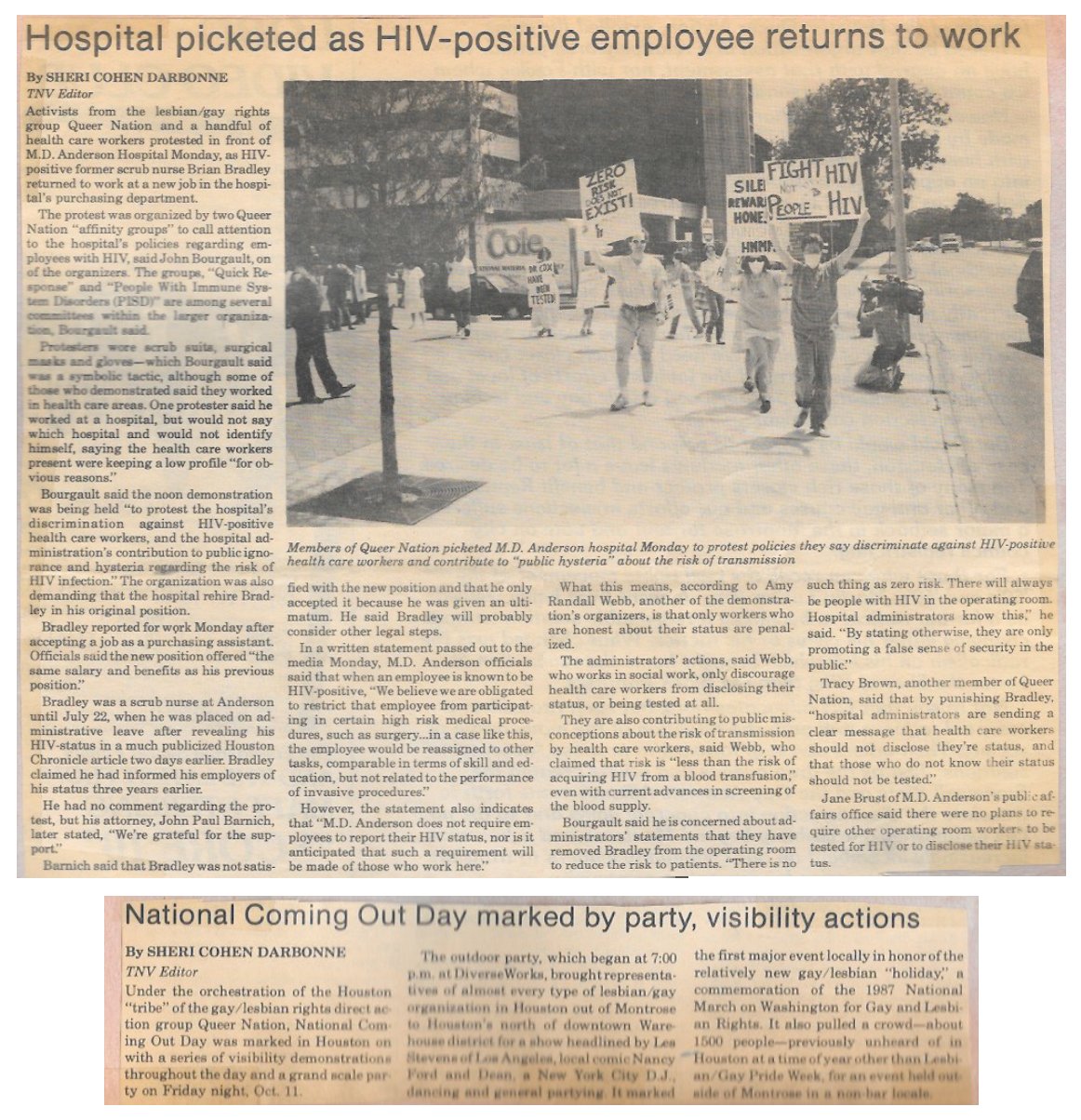
The
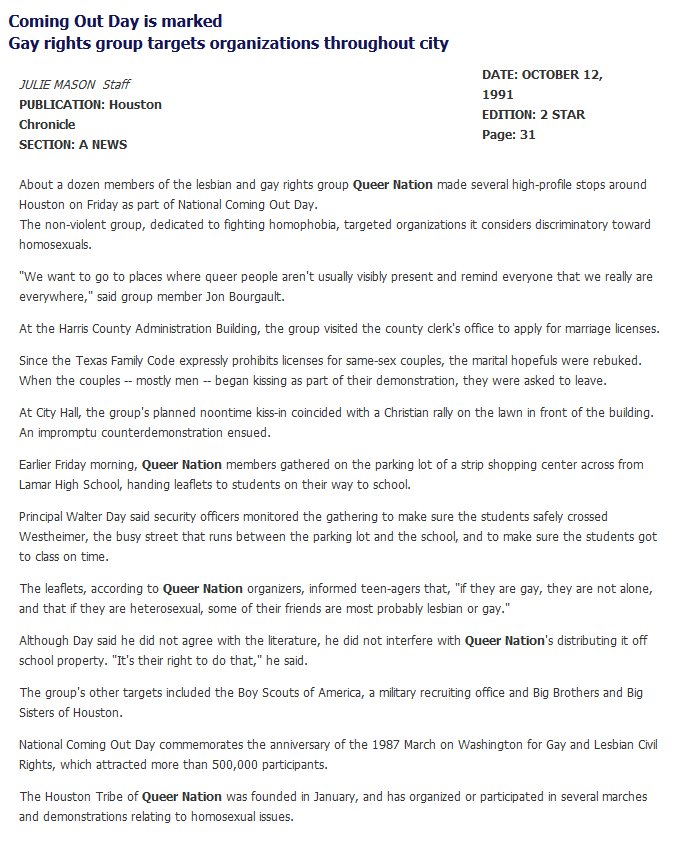
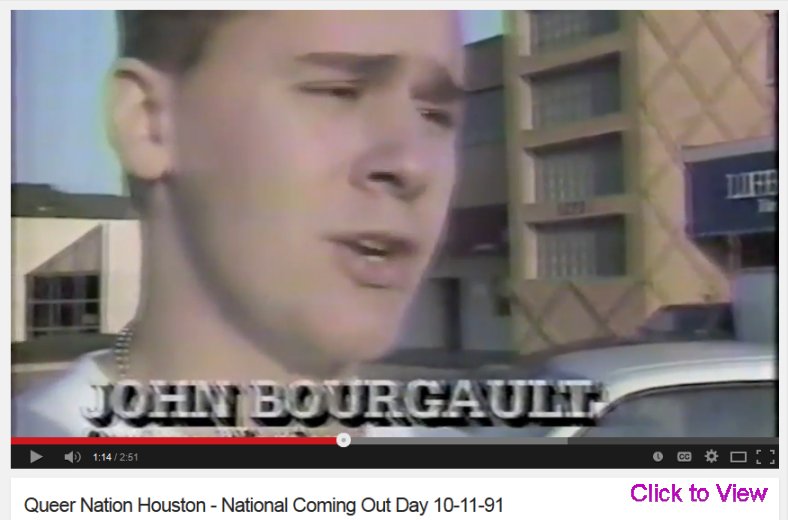
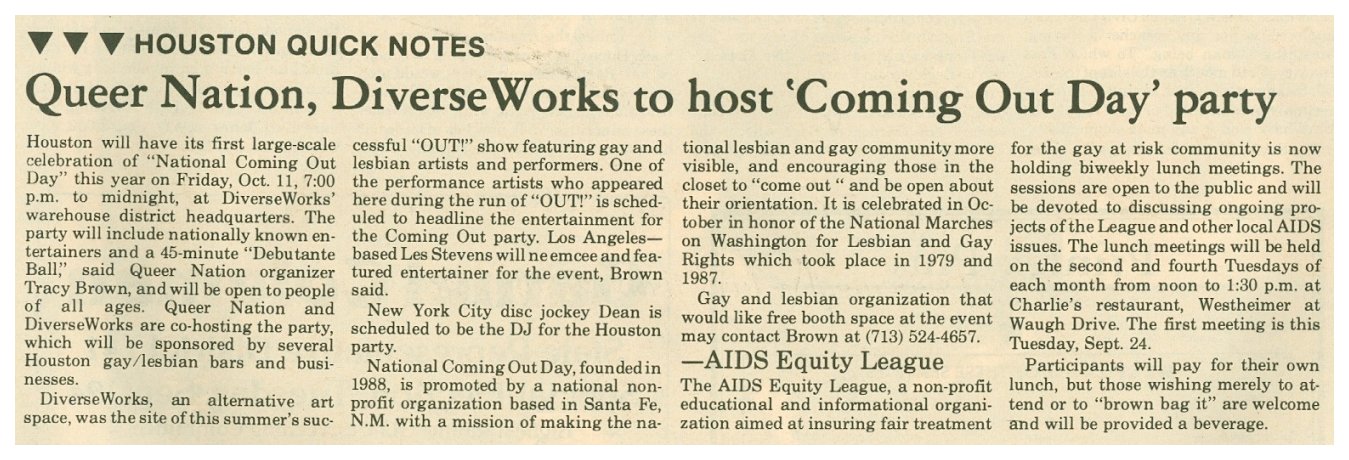
Coming Out Day party organized by Queer Nation Houston was held at DiverseWorks
(DW), then off of Main Street
and just north of the I-10 freeway. DW was an important alternative
arts space, often featuring performing and
visual works integrally related to the LGBT communities and to the queer
and AIDS movements.
During the August, 1992 Republican National Convention held in Houston,
QN-Houston and ACT UP
chapters from around the country were headquartered at the DW building.
Suggesting
the ongoing centrality then of the Montrose area for LGBT life, this
article, interestingly, notes:
It … pulled a crowd - about 1500 people - previously unheard of
in Houston at a time of year other than
Lesbian/Gay Pride Week, for an event held outside of Montrose in a non-bar
locale. (PM)
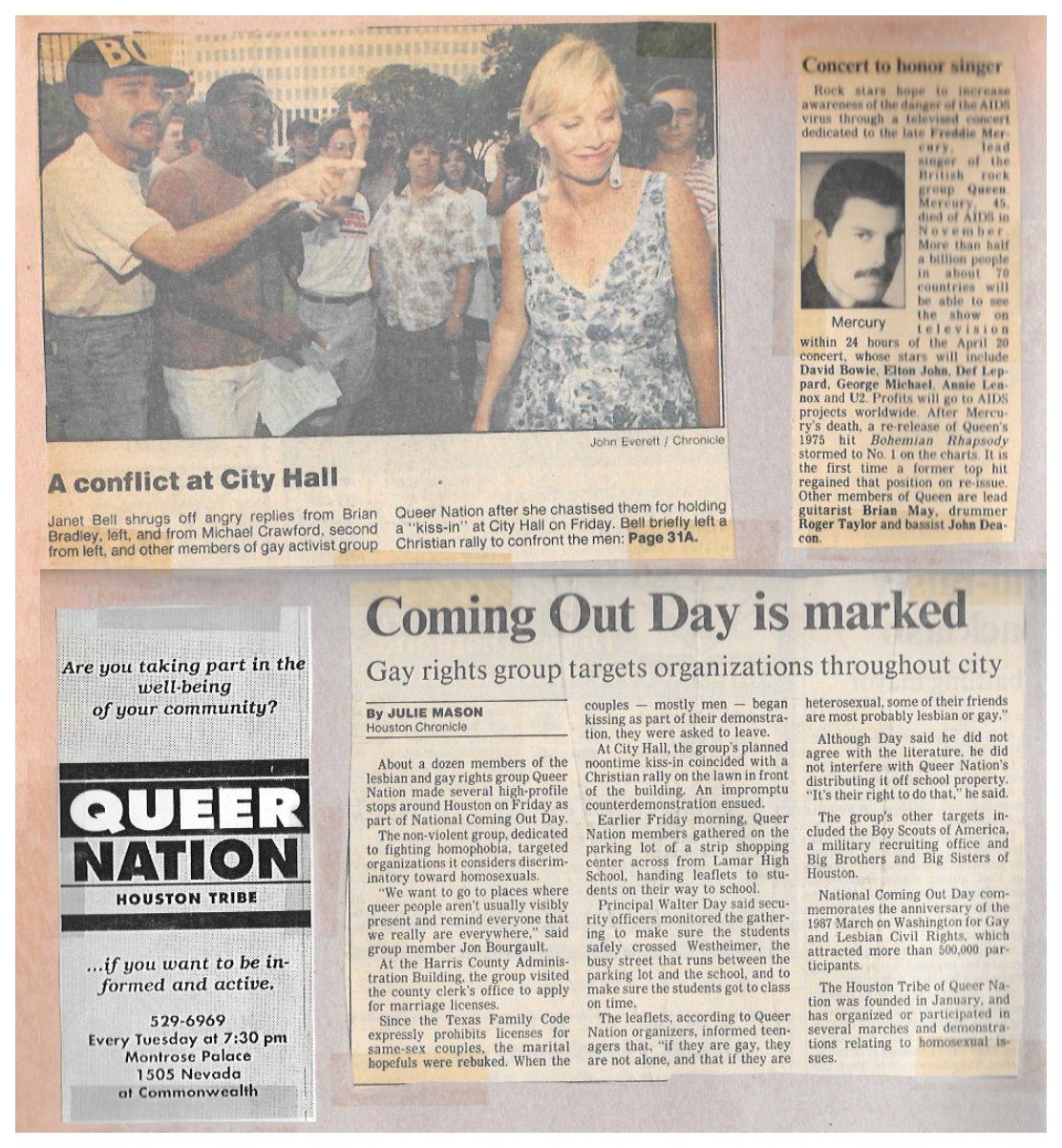
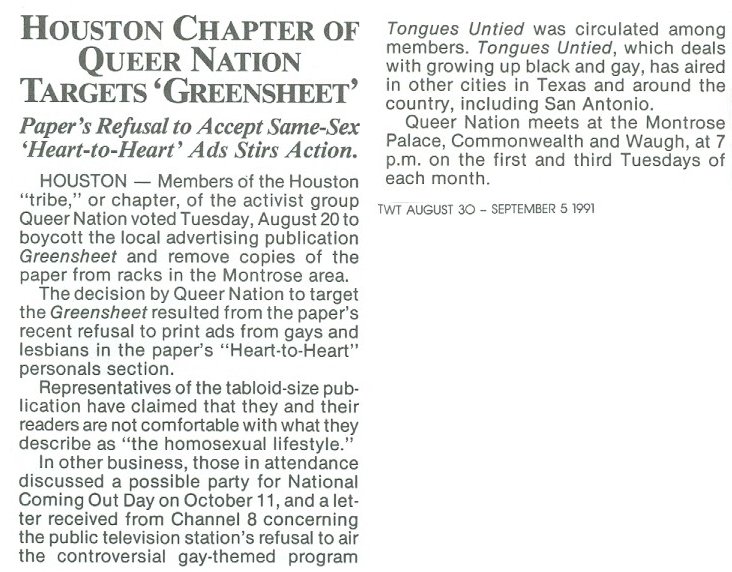
The pink
flier for Queer Nation Houston's Coming Out Day Celebration at DiverseWorks
lists some of the event's further sponsors.
These included clubs, bookstores (of the legitimate sort), clothing
stores, gyms, and a variety of LGBT bars
(some of which one would not have commonly associated with QN-Houston),
both in Montrose and farther afield.
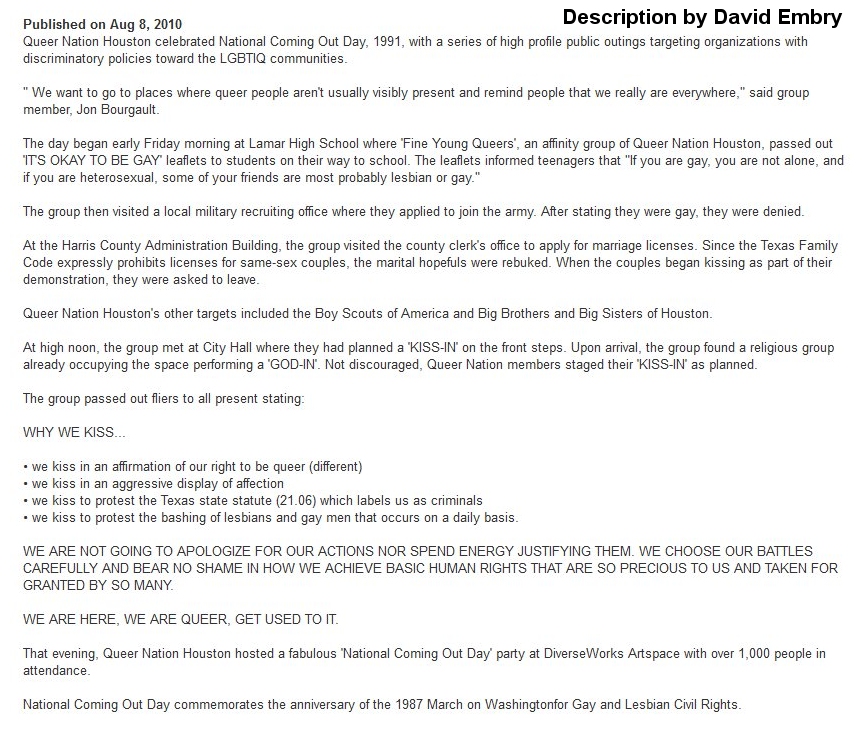
The white
"Why We Kiss" flier refers to the "Texas state statute
(21.06) which labels us as criminals."
The 21.06 anti-sodomy law was finally declared unconstitutional by the
US Supreme Court in 2003. (PM)


Palomo
Firing


Click
to View: Part
1 Part
2 Part
3 Part
4 Part
5 Part
6
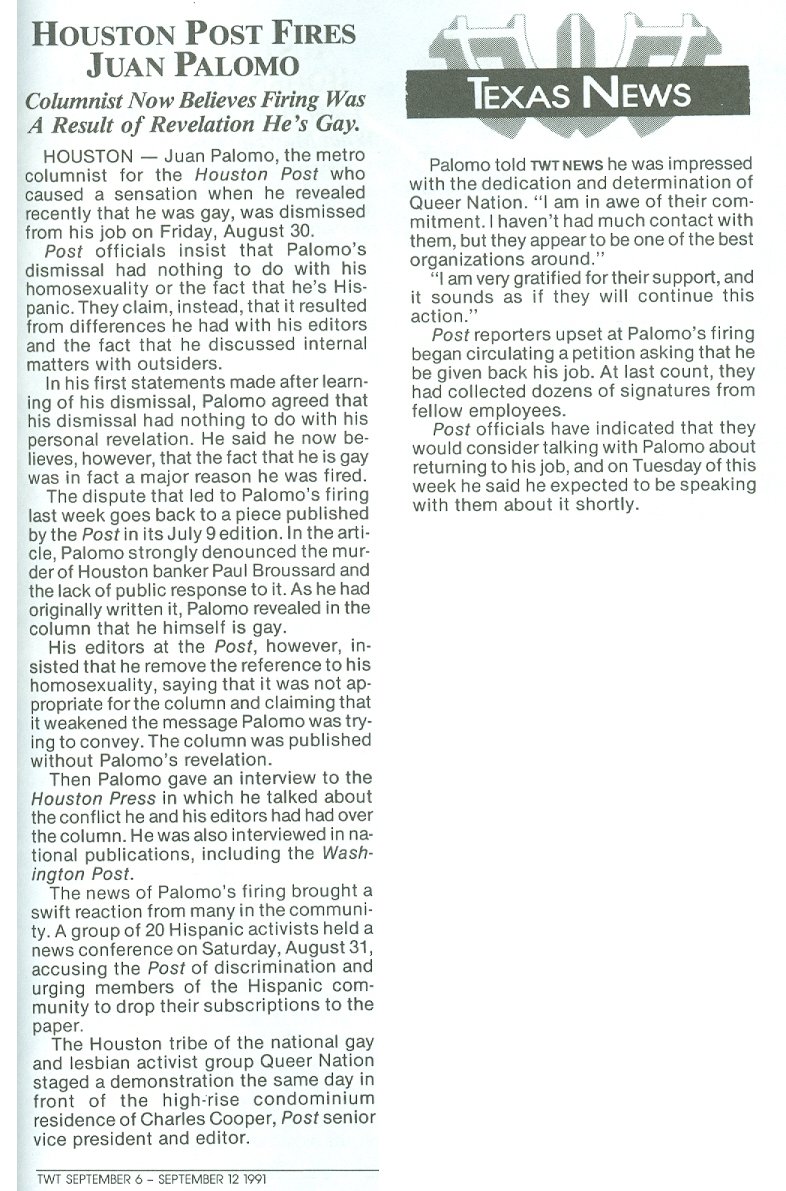
This
New Voice article below, "Juan Palomo rehired at the Houston Post
as 'op-ed' columnist", September 13-19, 1991, details the 1991
controversy around the newspaper and popular columnist.
Palomo
had written his regular column, one to appear on July 9, on hate crimes
and the recent gay-bashing murder of Paul Broussard.
Further, he had ended that submitted piece by coming of the closet as
a gay man. Post editors removed the last passage,
claiming that Palomo should not be discussing his sexuality, and published
a revised version of the column instead.
In
an extended discussion with the Houston Press, Palomo went public with
the dispute between Post management and himself.
He was fired from the Post on August 30, after turning down an offer
to work on the paper's editorial pages.
An
uproar ensued, with coverage in the national newsmedia. This article
"Gay activists picket editor's home, demand he rehire writer"
discusses one aspect of the broad responses from the Latino, LGBT, and
journalistic communities.
Queer
Nation Houston demonstrated in front of the high-rise residence of Post
editor Charles Cooper. Further, QN-Houston
member Tracy Brown indicates that the group will be voting, in its next
general meeting, on a proposed boycott of the newspaper.
Palomo
himself points to the questions of race and sexuality in his termination:
They (Post management) saw me as a direct challenge to their authority.
They saw me as an uppity Mexican and then they saw me as an uppity,
queer Mexican. (PM)

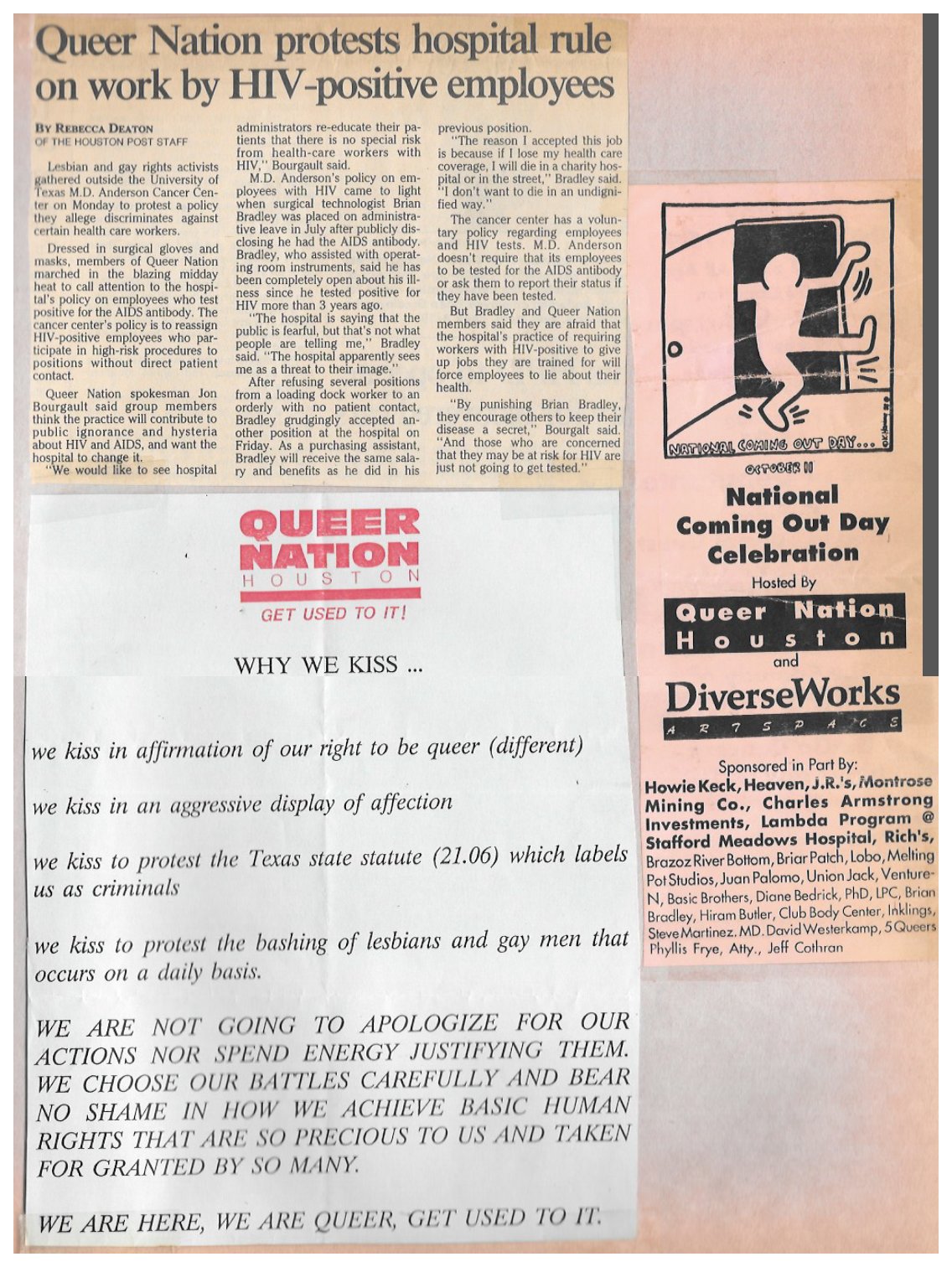
This
Houston Chronicle article "Ex-columnist Palomo and Post still talking"
indicates that Queer Nation Houston
had decided at its general meeting to begin a circulation and advertising
boycott of the Post, if Palomo was not rehired by Friday September 6.
Further,
the article notes a planned protest, by Latino organizations, at the
Post headquarters.
Part V of the video links, above, is a local news report on Palomo's
ultimate rehiring and features
comments from Yolanda Navarro Flores, an activist with Mexican-American
Democrats. (PM)

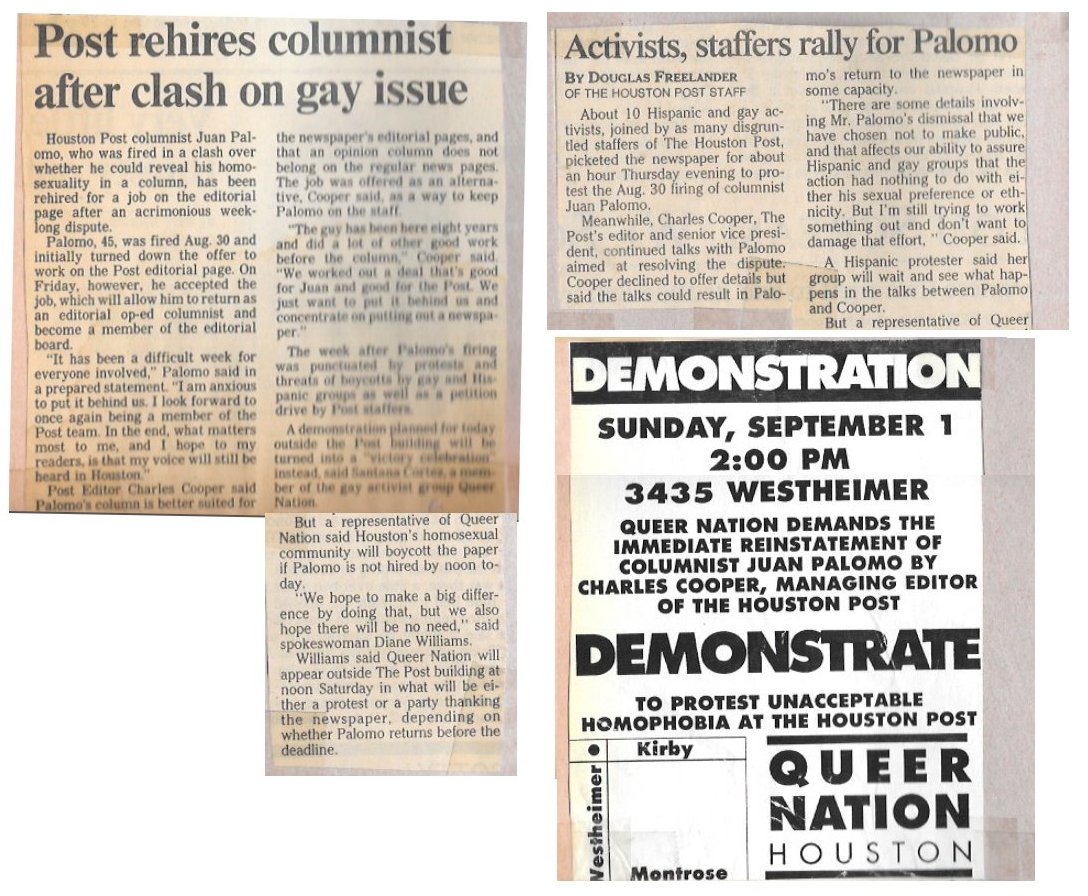
Palomo
was rehired at the Post after agreeing to take up the new editorial
columnist position - which he
had originally rejected - and a seat on the newspaper's board. Palomo
noted that would make him
"one of the few Hispanics and 'probably the first openly gay person'
to serve on an editorial board of a
major metropolitan daily newspaper."
This
article discusses another aspect of the response to Palomo's firing.
Post employees were
concerned not only about the columnist being silenced on "personal"
questions around his sexuality;
but also about "the ethical question of a newspaper trying to prevent
an employee from speaking to the media."
That was in reference to Palomo's going public, in the Houston Press,
on the controversy.
Many Post personnel were involved - alongside LGBT and Latino community
organizations - in demonstrations
concerning the case. (PM)





Per the
Montrose Voice article above, dated July 19-25, 1991 and titled "Unexpectedly
large crowd turns
out for 'Take Back the Streets' rally": Queer Nation Houston and
other LGBT community
organizations, such as the Caucus, proposed cultural sensitivity training
for the Houston Police Department.
This demand was raised by the Take Back the Streets march and at City
Council public forums in the wake of the Broussard killing.
The Houston
Chronicle article below, from October 16, 1991 and titled "Gays,
right-wing police group clash,"
reports on opposition to LGBT-inclusive sensitivity training from the
extreme-right John Birch Society's
Houston-Area Support Your Local Police Committee. The Society's head,
Robert W. Welch, Jr.,
had been notorious in the 1950s and 1960s after suggesting that US President
Dwight D. Eisenhower
was a pawn of international communism. (PM)


PDF
for 10/18/91 Voice article
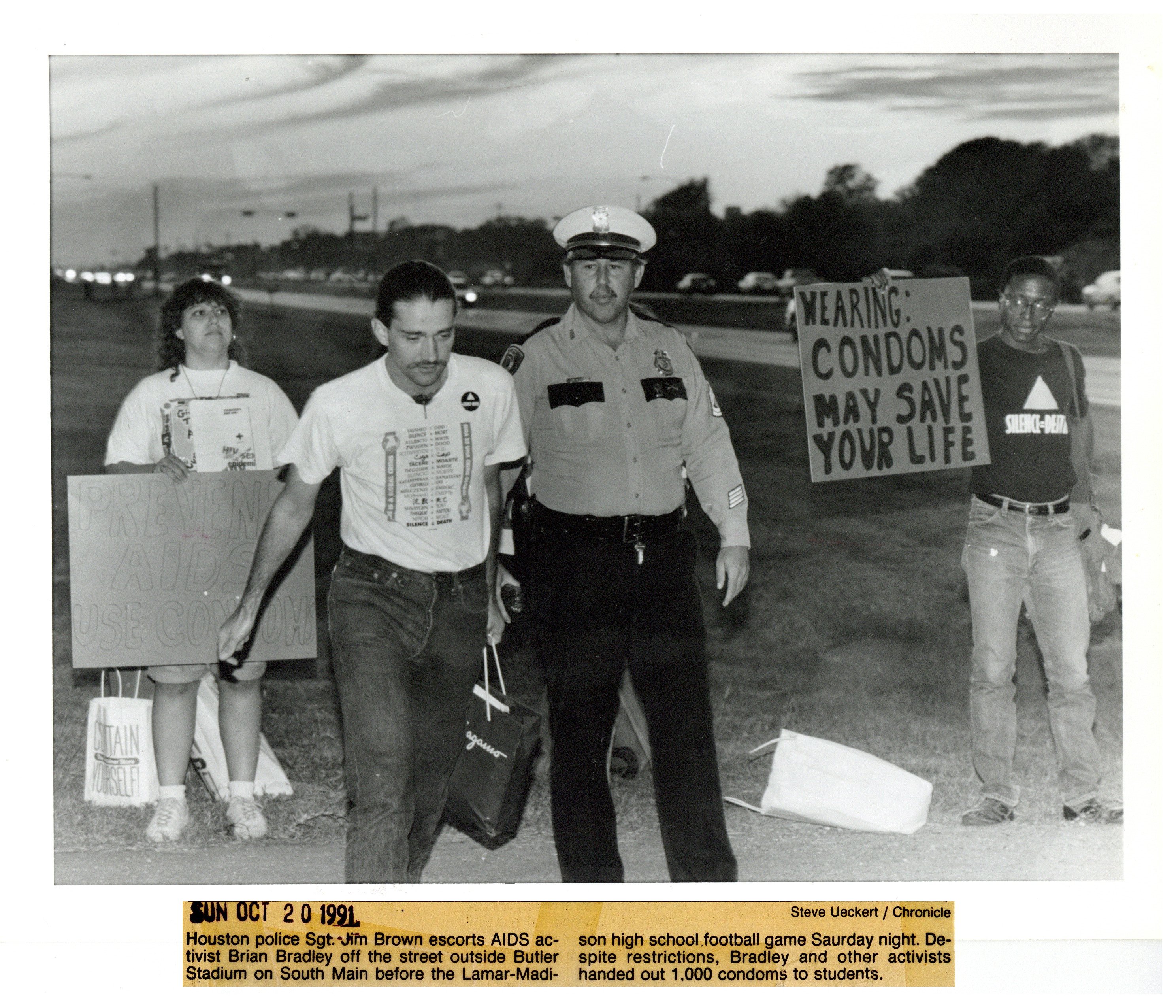
October
1991. AIDS Activists Brian Bradley and Diane Williams Shaw
and Michael Crawford
and others handed out over 1000 condoms outside of a Lamar-Madison
high school football game, and are escorted to another area. Diane's
sign says "Prevent AIDS Use Condoms"
This
article below notes different political groups protesting the visit
of Bush the Elder - including the local chapter of
NOW, the National Organization for Women. The women's and feminist movements
were, at that time,
one of the few, consistent allies that the LGBT movement had. (PM)


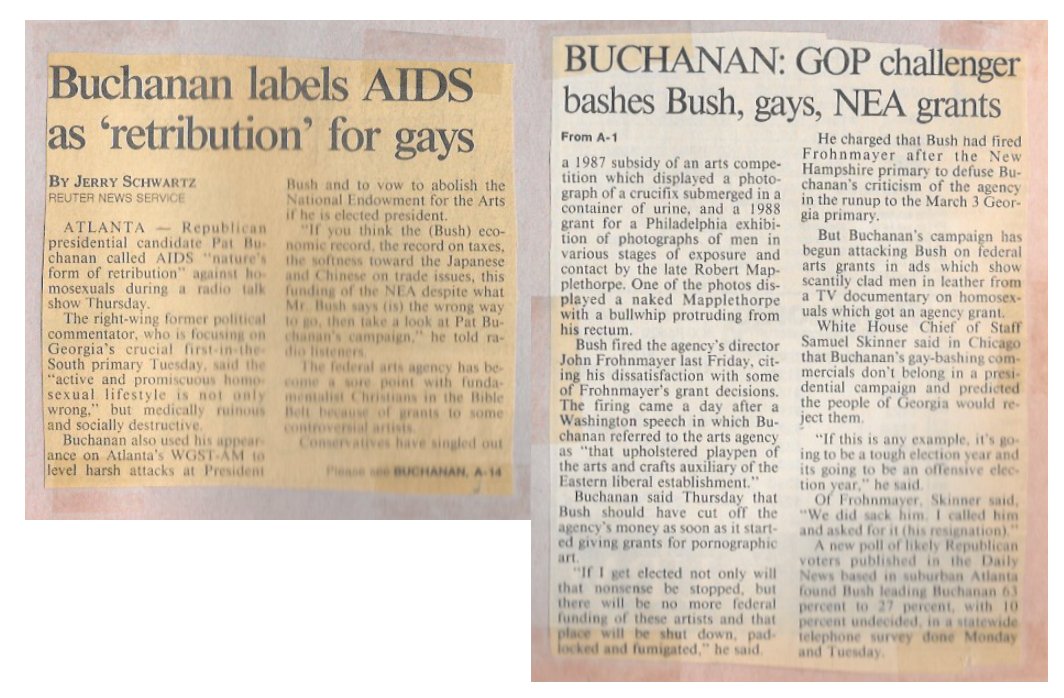
Patrick
Buchanan was a conservative commentator, for CNN and other media outlets,
and former
advisor to President Richard Nixon. He was running in Republican Party
primaries for the 1992
Presidential nomination. While ultimately unsuccessful, Buchanan was
to get a prime speaking slot at the
1992 Republican National Convention, held in Houston. There, his notorious
"culture war"
speech, broadcast to a national audience, attacked LGBT people, abortion
rights, feminists,
and many others and was a marked intensification of the right-wing offensive
apparent throughout the 1990s. (PM)


Below,
Phillip W Smith Murder
The November 3, 1991 antigay slaying of Phillip W. Smith was the first
homicide to be labeled a
hate crime by the Houston Police Department (HPD). Via pressure from
the LGBT communities
following the Broussard killing, the HPD definition of such a crime
was modified earlier that year to be
inclusive of sexual orientation. (PM)


Click
to View: Part
1 Part
2 Part
3 Part
4


Houston
Police Department (HPD) Chief Elizabeth Watson met with members of the
LGBT community
and organizations, including Brian Bradley of Queer Nation Houston,
over concerns about the Smith murder.
Per this article: "According to the gay representatives, HPD …
renewed its commitment to
sensitivity training." Further, and again per this article, Bradley
argues that such a training program which
"started early this year and was completed by 220 members of police
management staff is in
fact not the planned gay-specific program, but a more general 'cultural
awareness'
training on relating to minority groups. The other training, which was
to have been conducted by
Stafford Meadows Hospital, was put on hold."
There
had been prior controversy over such sensitivity programs. This is pointed
out in the above
article from the Houston Chronicle, dated October 16, 1991, and titled
"Gays, right-wing police group clash,"
on opposition from the John Birch Society and inside HPD itself. (PM)


A print
advertisement for film director Isaac Julien's 1991 release "Young
Soul Rebels" showed
two men embracing and was thus refused by the Houston Chronicle. It
was replaced by an alternate
ad showing two men flanking a woman.
The Dallas
Morning News, as well, had previously refused to run that ad. The Landmark
Theater company
threatened to pull all of its advertising, and the Morning News relented.
Landmark then had
alternative designs drafted - the two men flanking a woman - which ultimately
appeared in the Chronicle. (PM)

Per this
article, the Houston Chronicle had justified its refusal to run the
original Young Soul Rebels
advertisement by claiming it was a "'family'" newspaper. Landmark
Theater's local publicist,
Cynthia Reinhart, expressed surprise at the Chronicle's position, given
that it ran ads for adult films and clubs.
The Houston Post and the Houston Press used the original copy, with
the two men embracing.
The Voice
reveals that Landmark put pressure on the Dallas Morning News, only
after local LGBT community
activists there had coordinated a telephone call-in campaign to pressure
the theater company. (PM)

PDF
for 12/27/91 article

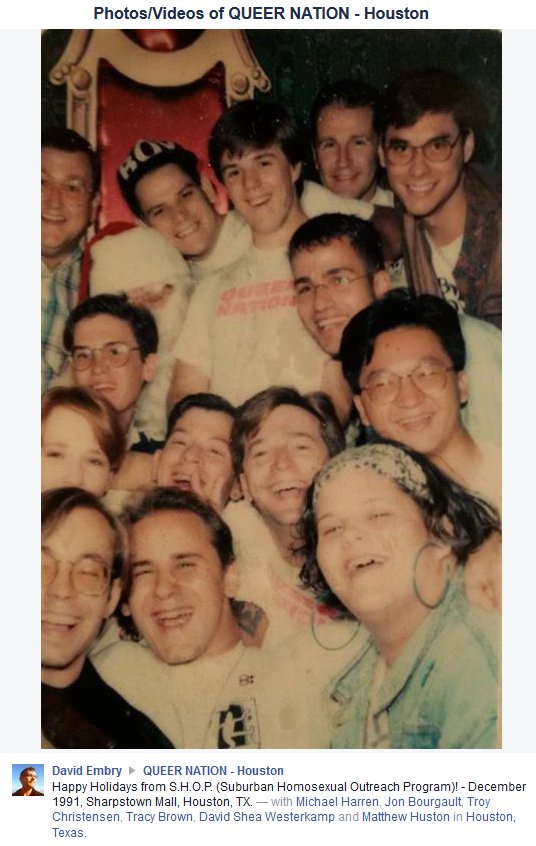
Below,
from article highlighting most important news stories of the year 1991
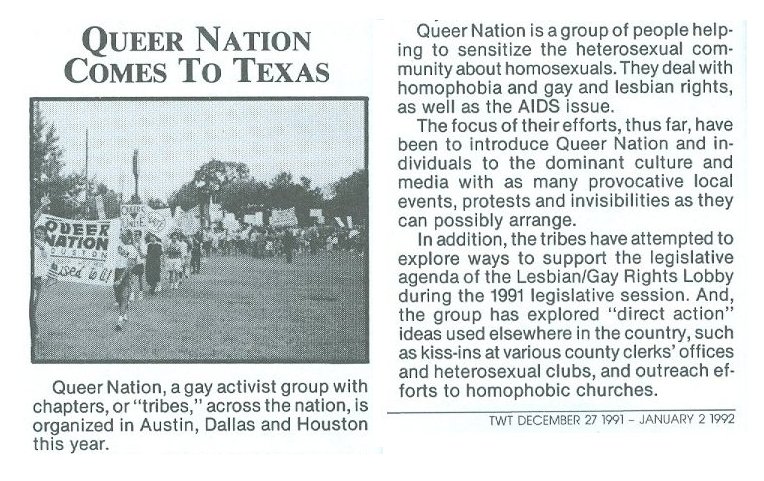
On
to 1992

Andrew Edmonson audio,
after QN panel, talking about
the Queer Nation efforts. 1:17. LINK
|


